
Every vending machine distributor faces the same sales risk: a new product can look impressive in a brochure and still fail to create reliable orders. If demand is not demonstrated before launch, every additional model can become stock risk, staff training, spare-parts complexity and another difficult conversation with buyers. The better question is not whether a machine looks innovative. It is whether a right site, a customer profile and a product mix give the format a reason to be purchased.
So, will customers actually buy a MAYCHI AI Smart Cooler? [https://www.maychi.com/products] They can when the distributor proves that the format solves a real retail problem at a suitable location. The strongest sales case is. Here is how people shop, here is what the operator can see, and here is evidence that the setup fits the location, product packaging and operating model. That is a more credible promise than claiming that one machine is right for every customer.
The distributor question hiding behind “Will it sell?”
A distributor is not paid for knowing that a unit can vend. Revenue comes from matching target customers, location constraints, a product category, assortment logic and a support plan. Before adding a MAYCHI AI Smart Cooler to the products offered, the sales team should establish whether the prospect has real customer pain points that older formats do not solve. This is where high quality discovery matters more than a polished pitch.
Does the prospect's product mix include shapes, sizes or product packaging that are poorly served by fixed spiral selections?
Does the customer profile support refrigerated self-service retail, and does the target audience understand the proposed shopping flow?
Can the operator use the available sales information and device information to make restocking, assortment or service decisions?
Can the distributor demonstrate the workflow, using the specific product, payment path and product examples proposed for the site?
Can both parties define a pilot, a support plan and a clear scale-or-stop decision before an inventory commitment?
Clear answers turn a machine into a right retail solution. Unclear answers are a signal to keep learning, narrow the use case or disqualify the opportunity. That discipline protects both working capital and the customer relationship.
Why spiral vending is not wrong. But May not fit every assortment
Traditional spiral vending remains useful in many sites. It is familiar, structured and right for products that fit the available coils and delivery mechanism. Yet that same structure can restrict product dimensions, packaging, presentation and product mix flexibility. A prospect with a broader chilled-product mix may need a retail format that better matches how the products are displayed, selected and replenished.
The purpose of a smart cooler is not to claim that it must replace every traditional machine. It is to give vending machine distributors another option when merchandising, consumer interaction or daily visibility makes a conventional layout less suitable. For example, different types of products, including approved packaged ingredients or raw materials for a business customer, may call for a different presentation and temperature-management conversation. The exact compatibility must still be verified.
What a distributor must prove before placing a large order
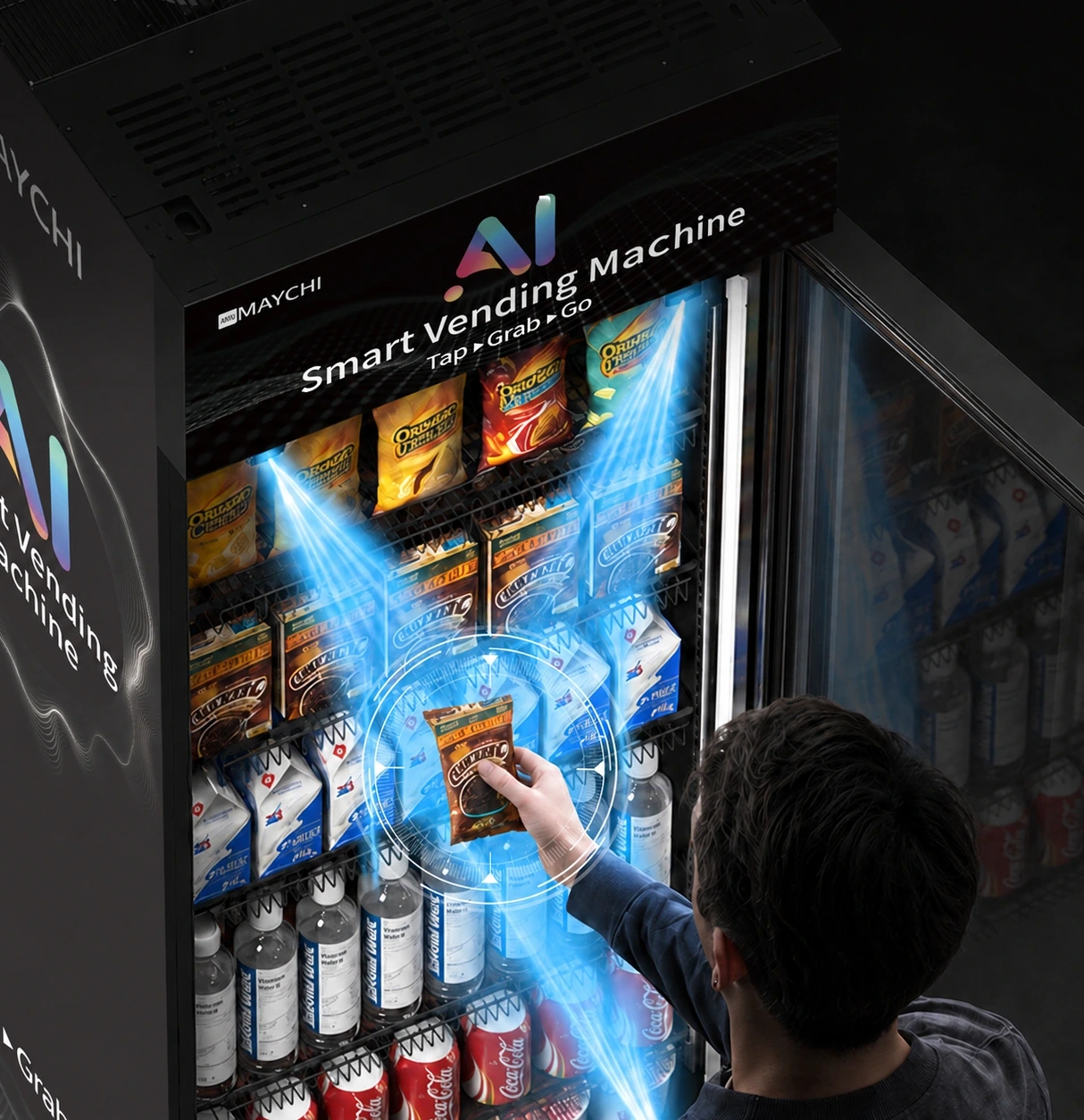
Proof should be built in five connected areas. First, prove the consumer journey with a working demo that shows how the user encounters, selects and pays for the proposed product. Use the actual setup whenever possible and identify site, payment, network, account or software dependencies in plain language. A live demo is more useful than a feature list because it replaces guesswork with clear action.
Second, prove the operator workflow. According to the supplied MAYCHI framework, a sales discussion can be supported with back-end sales and device data. Show only the information available to the proposed setup and permissions. Confirm which fields, alerts, reports, integrations and refresh behavior apply to the target markets. Explain how that sales information might support routine decisions such as refilling, device checks, product mix review and exception follow-up. Do not imply that unavailable data is included.
Third, prove site and assortment fit. Use a real location brief, not a generic industry label. Record opening hours, traffic pattern, usable space, power and network conditions, temperature requirements, customer base, likely basket, product cost, product packaging, refill frequency, security considerations and local compliance needs. These details help a distributor meet customer expectations with an offer built for that site rather than a generic catalog entry.
Fourth, prove sales logic. Do not promise revenue without site evidence. Build a clear model using variables the prospect can challenge: expected transactions, average basket value, gross margin, payment costs, product cost, waste, replenishment labor, service expense, site fees, financing and taxes. Separate real facts, customer-provided data, supplier-provided data and estimates. Fifth, prove support planning: explain installation, start-up, operating training, help routes, spare parts, warranty boundaries and current service coverage.
A seven-step proof-first MAYCHI sales process
Qualify the use case. Identify the products or services involved, shoppers, site constraints, current retail method and business problem. Disqualify poor-fit opportunities early.
Configure the demo. Match hardware, software, connectivity, payment and product examples as closely as practical to the intended deployment.
Demonstrate the purchase experience. Let the prospect observe or complete the customer journey, then capture questions, friction and setup requirements.
Demonstrate operator visibility. Show the approved back-end view and explain what every metric can, and cannot, prove.
Present approved evidence. Use customer cases, photographs, references or aggregated use examples only with authorization and useful context.
Run a controlled pilot when needed. Agree owners, baseline, review period, success thresholds, issue log and a stop-or-scale date.
Convert learning into a rollout proposal. Use observed results and customer feedback to recommend the product assortment, training, replenishment and support plan.
Use data to support a decision, not to manufacture certainty
The goal of a demo is not to display every screen. It is to connect available information to an daily decision. Depending on the MAYCHI setup and permissions, verify relevant categories such as sales activity, device status, inventory or assortment signals, exception handling, reporting and integrations. A live, permission-right view is stronger than a screenshot because the buyer can understand how data is generated, refreshed, filtered and used. Protect customer-confidential, personal and payment data throughout the process.
Market strategies should be based on the evidence collected, not on a generic claim of innovation. A distributor may segment target customers by location type, product category, consumer need or daily ability. That lets the sales team focus resources on the target markets where the customer profile, product mix and support model are most likely to align. It also makes it easier to explain why the product is a fit - or why a simpler alternative is better.
Answer objections with transparent economics and fit
When a prospect asks, “What if I buy stock and cannot sell it?”, begin with qualified demand, demo units, pilot commitments or a limited first order. Set reorder triggers based on pipeline quality and installation capacity, not optimism. When asked why a customer should choose this over a spiral machine, compare the formats against the actual assortment, package dimensions, shopping experience, daily workflow and total cost. If spiral vending fits better, say so.
No responsible supplier or distributor should guarantee sales or return on investment without controlled evidence. Present a base case, a downside case and a break-even view. Label inputs clearly. A smart cooler may be worth evaluating where refrigerated self-service retail, appropriate product packaging, remote daily visibility, reliable servicing and compliant site conditions come together. It may be a weak fit where demand is unproven, connectivity is unreliable, security risk cannot be managed or unit economics remain negative.
The evidence pack that helps a distributor close responsibly
Before requesting an order, assemble a buyer-ready proof pack. A working demo using the proposed setup. A concise site and assortment qualification record. Approved customer cases with date, market, scope and limitations. An authorized back-end walkthrough. A transparent economics worksheet. A pilot plan. And current technical specifications, warranty, support scope and compliance documentation. This package gives the buyer a path to verify the claims, not merely receive them.
Conclusion: sell proof before inventory
MAYCHI gives distributors a starting point beyond a brochure.
[https://www.maychi.com/resources/downloads] A working demo, real application scenarios, customer evidence and back-end sales and device information, subject to setup and approval. The distributor's job is to connect those assets to a right site, validate the exact model and terms, and let the customer see how the retail model works before asking for commitment. That approach does not eliminate risk. It makes risk visible, measurable and manageable - the difference between adding a model to a catalog and building a product line with a reason to be purchased.
Used this way, a disciplined first installation creates a referenceable learning loop: validate the commercial hypothesis, improve the product mix, strengthen service readiness, and decide whether broader local expansion remains justified.

